Mahan Goes To War: Effects Of World War I On The US Navy's Force Structure And Operational Planning by LCDR Brandon E. Todd USN
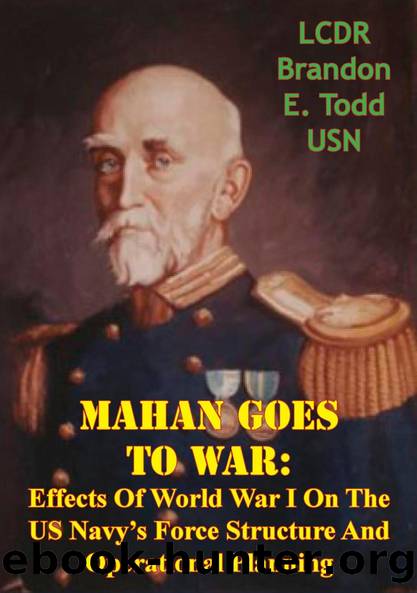
Author:LCDR Brandon E. Todd USN [USN, LCDR Brandon E. Todd]
Language: eng
Format: epub
Tags: History, Military, Iraq War (2003-2011), Persian Gulf War (1991), United States, Aviation
ISBN: 9781786252845
Google: DjVvCwAAQBAJ
Publisher: Pickle Partners Publishing
Published: 2015-11-06T02:58:58+00:00
âFor many years Admiral Mahan had been instructing American naval officers that the first rule in warfare is not to divide your fighting forces, but always to keep them together⦠Undoubtedly, the best method which Germany could use to keep our destroyers in our own waters would be to make the American people believe that their lives and property were in dangerâ¦â{86}
Historians differ on how instrumental Simsâ advocacy was in the adoption of the convoy, but soon after Simsâ arrival, the Admiralty endorsed the concept. On 27 April, Admiral Jellicoe approved a memo recommending merchant convoys, and soon thereafter conducted a successful test of the concept.{87} U.S. merchant convoys commenced the next month, with the first departing Hampton Roads, Virginia, on 24 May and arriving safely in Britain in early June.{88} By the end of the war, the convoy system had proven itself the single most effective tactic against the German submarine. Survival rates of merchants sailing in convoy were vastly higher than those of lone merchants,{89} and finally reduced the hemorrhaging of merchant tonnage to bearable levels. Since a group of merchant ships was approximately as easy or difficult for a submarine to detect as a single ship, arranging merchants in convoys presented fewer effective targets to the enemy. Furthermore, placing the submarineâs quarry together with warships forces allowed anti-submarine forces a much better chance of finding targets than the mostly fruitless open-ocean patrolling. Of course, the Germans adapted by, among other things, operating closer to the coast, but never again did merchant tonnage sunk approach its April 1917 peak after convoys were introduced. During the eighteen months of their involvement in the war, U.S. destroyers escorted almost 19,000 ships through contested waters, endured 183 attacks by enemy submarines, destroying 2 U-boats and damaging 24.{90}
Differing views on the proper conduct of the naval war remained a source of tension throughout the conflict. Benson, Daniels, and Wilson were unsatisfied with what they saw as Britainâs inept and overly defensive conduct of the anti-submarine campaign and wished for a more offensive, âAmericanâ war at sea. Despite acquiescing to the adoption of convoys escorted by U.S. destroyers, the three leaders wanted to take the fight to the enemy in a more obviously direct manner, to include attacking German controlled submarine ports and emplacing a barrage across the North Sea between Scotland and Norway. President Wilson made his views clear in a speech aboard the USS Pennsylvania on 11 August 1917, stating, âWe are hunting hornets all over the farm and leaving the nest alone. â¦. I am willing to sacrifice half the navy Great Britain and we together have to crush that nest, because if we crush it, the war is won.â{91} In addition to the President, Secretary Daniels, and Admirals Benson and Mayo, many British leaders also pressed for direct action against submarine bases, including Winston Churchill and Admiral Jackie Fisher.{92} Responding to these pressures, the Admiralty drew up a plan for using sunken merchant ships to block the exits to submarine ports on the Heligoland Bight.
Download
This site does not store any files on its server. We only index and link to content provided by other sites. Please contact the content providers to delete copyright contents if any and email us, we'll remove relevant links or contents immediately.
The Vikings: Conquering England, France, and Ireland by Wernick Robert(84385)
Ali Pasha, Lion of Ioannina by Eugenia Russell & Eugenia Russell(40322)
The Conquerors (The Winning of America Series Book 3) by Eckert Allan W(37991)
The Vikings: Discoverers of a New World by Wernick Robert(37008)
Cecilia; Or, Memoirs of an Heiress — Volume 1 by Fanny Burney(32640)
Cecilia; Or, Memoirs of an Heiress — Volume 2 by Fanny Burney(32014)
Cecilia; Or, Memoirs of an Heiress — Volume 3 by Fanny Burney(31998)
Empire of the Sikhs by Patwant Singh(23140)
The Secret History by Donna Tartt(19314)
Hans Sturm: A Soldier's Odyssey on the Eastern Front by Gordon Williamson(18653)
Cat's cradle by Kurt Vonnegut(15447)
Pimp by Iceberg Slim(14687)
Sapiens: A Brief History of Humankind by Yuval Noah Harari(14467)
Norse Mythology by Gaiman Neil(13460)
Talking to Strangers by Malcolm Gladwell(13449)
Leonardo da Vinci by Walter Isaacson(13414)
4 3 2 1: A Novel by Paul Auster(12523)
Underground: A Human History of the Worlds Beneath Our Feet by Will Hunt(12149)
The Radium Girls by Kate Moore(12097)
